
What Are Thermal Labels?
Thermal labels are labels printed using heat rather than inkjet or laser toner. They are widely used for shipping, barcodes, warehouse management, retail, and product identification.
There are two main types of thermal labels:
- Direct thermal labels – printed directly on heat-sensitive paper without ribbon, commonly used for shipping labels and short-term applications.
- Thermal transfer labels – printed using a ribbon, offering better durability for long-term storage, higher temperatures, or harsher environments.
Choosing the right type depends on how and where the label will be used.
Step-by-Step: How Thermal Labels Are Manufactured
Step 1: Confirm the Label Requirements
Production starts by confirming all technical requirements with the customer, including:
- Label type: direct thermal or thermal transfer
- Label size and shape
- Core size and roll winding direction
- Adhesive type (permanent, removable, freezer, etc.)
- Blank or pre-printed labels
- Packaging and labeling requirements
For custom thermal labels, our typical MOQ starts from 500 labels, allowing customers to test new sizes or applications with lower risk.
Frequently produced sizes include 100×100mm, 100×150mm, 100×40mm, 100×50mm, and many other custom dimensions. Customers are welcome to send their required size for confirmation.
Step 2: Raw Material Selection
Based on the application, suitable materials are selected, including:
- Thermal paper or coated facestock
- Appropriate adhesive for the surface and environment
- Release liner to ensure smooth dispensing
Material selection directly affects print quality, adhesion, and printer compatibility, so this step is critical for stable performance.
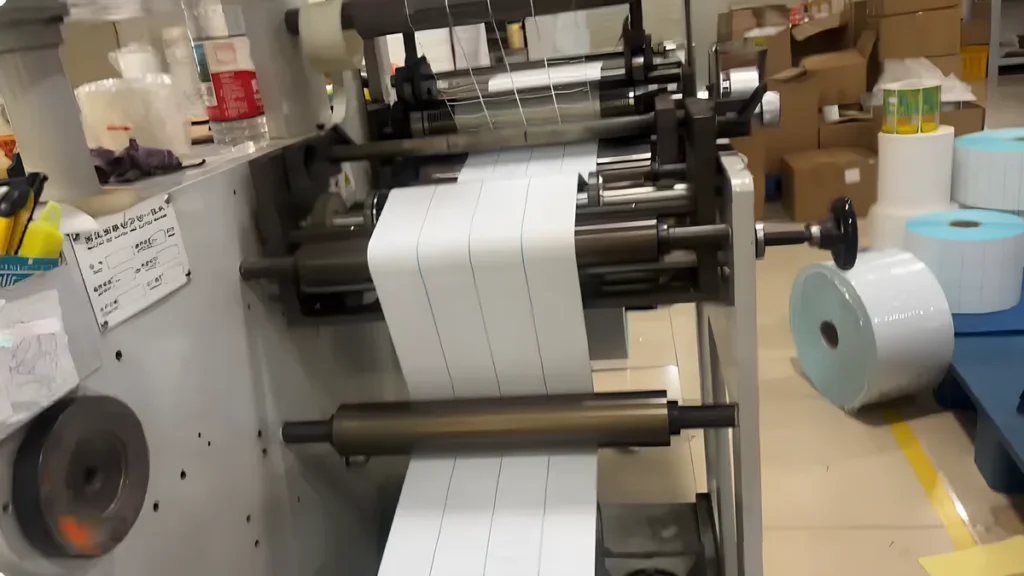
Step 3: Slitting Jumbo Rolls
Large jumbo rolls are slit into narrower rolls according to the final label width.
Accurate slitting ensures:
- Clean edges
- Consistent roll tension
- Smooth feeding on thermal printers
Poor slitting can cause printer jams, uneven feeding, or label misalignment.
Step 4: Printing (If Labels Are Pre-Printed)
If the labels require logos, text, barcodes, or branding, printing is completed before die-cutting.
During this stage, attention is paid to:
- Print clarity
- Color consistency
- Alignment and registration
- Barcode readability (when applicable)
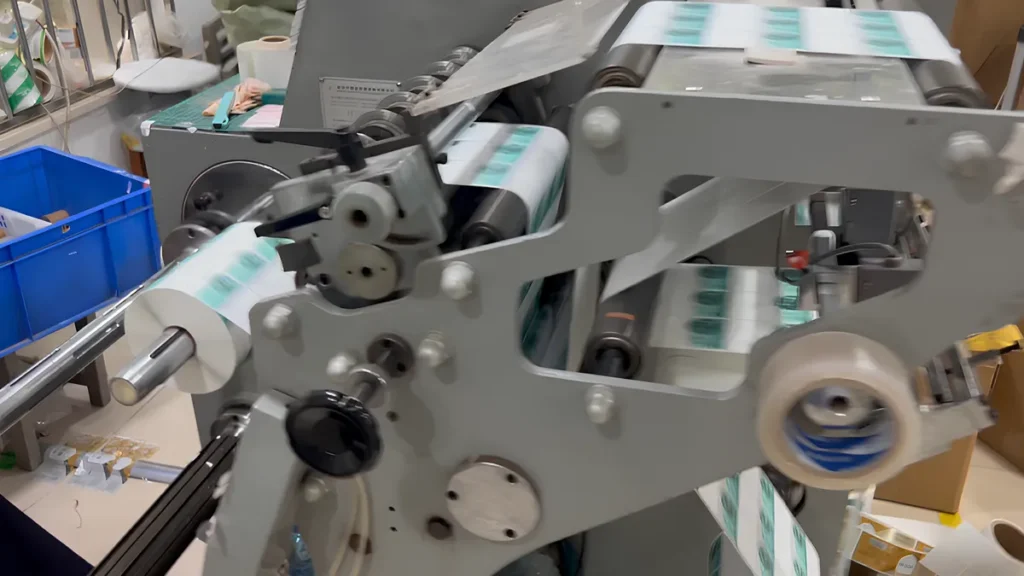
Step 5: Optional Coating or Protection
Depending on the application, labels may receive additional surface protection, such as top-coating or lamination, to improve resistance to moisture, abrasion, or handling.
For many shipping and logistics labels, this step is optional to keep costs competitive.
Step 6: Die-Cutting
Die-cutting shapes the labels while keeping the liner intact. Options include:
- Standard rectangles or squares
- Rounded corners
- Custom shapes
Precise die-cutting helps ensure smooth dispensing and consistent application.
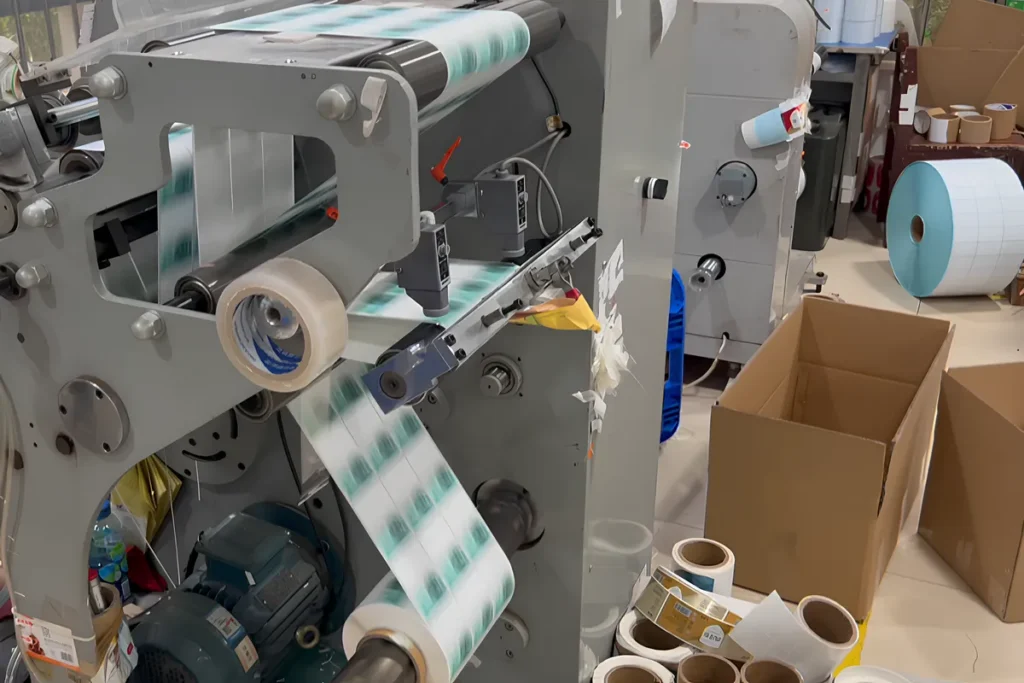
Step 7: Matrix Removal
After die-cutting, excess material around the labels is removed.
Clean matrix removal ensures tidy label edges and stable roll performance.
Step 8: Rewinding and Roll Configuration
Finished labels are rewound according to customer requirements, including:
- Core size
- Winding direction
- Labels per roll
- Maximum roll diameter
This step ensures compatibility with the customer’s printers or labeling machines.
Step 9: Quality Inspection
Before packing, labels go through routine production checks, which may include:
- Visual inspection for coating or surface defects
- Dimensional checks
- Roll condition and edge alignment checks
- Printer testing to confirm smooth feeding and print performance
These inspections help ensure consistent quality before shipment.
Step 10: Packaging and Shipping
Labels are packed according to order requirements, such as:
- Individual shrink wrap
- Inner box and carton labeling
- Protective packing for long-distance shipping
Proper packaging helps protect labels during international transportation.
Direct Thermal vs. Thermal Transfer: Manufacturing Differences
While many production steps are similar, the key differences include:
- Material selection: direct thermal paper vs. thermal transfer facestock
- Durability considerations: thermal transfer labels are designed for longer life
- Testing focus: thermal transfer labels require ribbon compatibility testing
Understanding these differences helps customers select the right solution.
Common Manufacturing Issues and How to Avoid Them
Labels fade or darken over time
Direct thermal labels are sensitive to heat and light. For longer durability, thermal transfer labels are recommended.
Labels lift or peel
Adhesive selection must match the surface and environment.
Printer feeding problems
Often related to roll configuration, slitting accuracy, or core size mismatch.
Barcode scanning issues
Proper print contrast, sizing, and testing are essential for reliable scanning.
FAQ
What is your minimum order quantity (MOQ)?
Our typical MOQ for custom thermal labels starts from 500 labels, depending on size, material, and printing requirements.
What is the standard production lead time?
For most standard orders, the production lead time is 7–10 days after order confirmation and material readiness.
Can you support custom sizes?
Yes. In addition to common sizes such as 100×100mm, 100×150mm, 100×40mm, and 100×50mm, we support many other custom dimensions. Customers are welcome to send their requirements for confirmation.
Do you manufacture both direct thermal and thermal transfer labels?
Yes. We produce both direct thermal and thermal transfer labels to suit different applications.
✉️Request a Custom Quote
Looking for a reliable custom thermal label manufacturer? We provide professional solutions for direct thermal and thermal transfer labels with flexible sizes, stable quality, and competitive MOQs to support your business growth.
To provide you with an accurate quotation, please include:
- Label Size & Quantity (e.g., 4″ x 6″, 50,000 labels)
- Label Type (Direct Thermal or Thermal Transfer)
- Application Environment (e.g., Cold storage, outdoor use, or shipping)
- Core Size & Winding Direction (For machine application)
👉 [Click Here to Contact Us] or send your requirements to our team for a fast response and free samples.